
Anping, in Hebei Province, is one of the names most frequently encountered in global wire mesh sourcing. But the useful question for buyers is not simply whether the district is large. It is what a mature industrial cluster changes in the way products are specified, sampled, inspected, packed, and shipped.
A Chinese-language industry profile published in 2016 by a local manufacturer offers a detailed—if historical—view of that ecosystem. Its figures mainly describe 2011 and 2012, so they should not be treated as a current market report. They do, however, explain the production depth behind Anping’s long-standing position in wire mesh. Read the original historical profile.
A cluster built around more than one product
The source traces Anping’s wire mesh tradition to 1488 and describes the sector as a county-wide production and trading system rather than a collection of isolated factories. For 2011, it reported roughly 140,000 people working in the sector, about 12,000 wire-mesh industrial and trading businesses or sales points, and RMB 28.6 billion in industry output. Those are historical claims, but they illustrate the scale of specialization that sourcing teams still associate with the area.
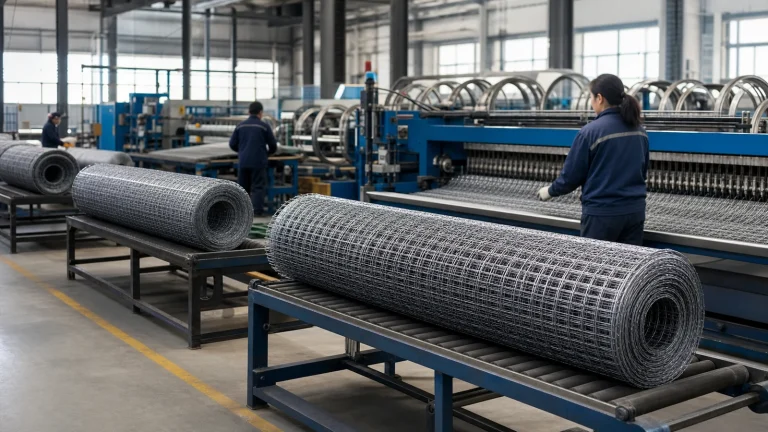
The profile also described a broad equipment and material base: wire drawing and weaving equipment, large volumes of wire rod and sheet input, and more than one billion square metres of mesh production. It grouped local output into six broad families—drawing, weaving, welding, punching-and-expanding, non-woven formats, and fabricated products—covering more than 400 product types and 6,000 specifications.
For buyers, that breadth matters because a wire mesh requirement rarely ends with a single roll of material. A fencing order may also need posts, gates, clips, barbed wire, packaging, and a coating specification. A filtration project may require different aperture ranges, wire grades, edge treatment, and traceability documents. A deep supplier base can reduce the number of separate vendors involved, but it does not remove the need for precise technical control.
Export capability is an advantage, not a substitute for verification
The historical article says Anping’s products were sold into more than 150 countries and regions, and that woven mesh held a large share of China’s production and exports. It also reported 2011 self-operated exports of US$510 million and export delivery value of US$1 billion. These are dated numbers, not evidence of a supplier’s current capacity, compliance status, or delivery performance.
That distinction is important. An export-oriented cluster usually means that forwarders, freight consolidation, inspection services, packaging suppliers, and trading companies are readily available. It can make mixed-container planning more practical. Yet a buyer should still determine which company actually controls the drawing, welding, weaving, galvanizing, coating, and final packing steps.
In a dense cluster, a quotation can be perfectly legitimate while the production chain is distributed across several firms. That can be efficient, especially for a mixed specification order. It can also create gaps if responsibility for wire chemistry, aperture tolerance, zinc coating, weld strength, or final inspection is left unclear.
The most useful lesson: separate cluster strength from factory strength
Anping’s historical advantage is ecosystem density. The source describes logistics, industrial parks, research institutions, testing, e-commerce, financing, machinery supply, trading markets, and an international trade show as parts of that ecosystem. This helps explain why the area can support both commodity products and more specialized mesh formats.
But cluster strength should be treated as a starting point for supplier discovery, not as a factory qualification result. Before placing an order, buyers should ask for evidence at the facility and product level.
1. Lock the material before comparing prices
“Galvanized wire mesh” is not a complete specification. Confirm the base wire grade, wire diameter tolerance, galvanizing method, zinc mass where applicable, coating thickness for PVC-coated products, and whether dimensions are measured before or after coating. For stainless products, confirm the grade and request mill or material documentation when the application warrants it.
2. Convert the application into measurable acceptance criteria
For welded mesh, define aperture tolerance, panel flatness, weld integrity, cut-edge condition, and acceptable damaged-wire limits. For woven mesh, define mesh count or aperture, wire diameter, weave type, roll width, roll length, and allowable variation. For filters, screens, and safety-critical uses, agree the sampling method and inspection record before production begins.
3. Verify the actual production route
Ask whether the supplier draws wire in-house, buys finished wire, owns the welding or weaving line, uses external galvanizing, or outsources fabrication. There is no universal “right” answer. The right answer is a supply chain that is visible, repeatable, and matched to the required lead time and quality level.
4. Inspect packaging as an engineering decision
Mesh is vulnerable to crushed roll edges, moisture, coating abrasion, and mixed-specification mistakes. Require a packing plan that identifies roll labels, pallet or frame support, moisture protection, loading orientation, and how different apertures or gauges will be separated in a shared container.
5. Treat compliance as market-specific
Fencing, construction mesh, agricultural mesh, mining screens, architectural mesh, and filtration products can face different test, labelling, material, or documentation expectations. A supplier’s experience in one destination market does not automatically transfer to another. Match the evidence to the end use and importing country.
Why the historical record still matters
The source’s central message is that Anping developed as an integrated manufacturing-and-trade hub. Even though the statistics are more than a decade old, the profile is useful because it describes the logic of a cluster: specialization, supporting services, a wide product catalogue, and export-facing infrastructure.
That context can help a buyer build a smarter sourcing plan. Start by mapping the product family and application. Then identify whether the order needs a single specialist factory, a fabricator with in-house control of multiple steps, or a coordinated group of suppliers. Finally, qualify the physical product through drawings, samples, pre-production approval, and documented inspection—not through regional reputation alone.
For global procurement teams, the practical takeaway is simple: Anping’s scale can make it an efficient place to search, compare, and consolidate. The purchase decision should still rest on a current specification, a transparent manufacturing route, and measurable quality evidence.
Historical-source note
This article uses figures from the 2016 Anping wire mesh industry profile. The original page reports data for 2011–2012. Wire Mesh Guide has not represented those figures as current estimates or independently verified every historical claim.