
Wire mesh is a broad family of products made by interlacing, welding, twisting, expanding, perforating, knitting, or otherwise forming wire and metal sheet into repeated openings. The opening may control flow, retain particles, provide protection, reinforce a surface, contain stone, guide animals, or create an architectural finish. The common word “mesh” is useful, but it is not a complete specification.
The clearest way to classify wire mesh is by construction first, then by material, finish, dimensions, and intended use. This approach prevents a buyer from treating a welded panel, a woven screen, and a perforated sheet as interchangeable merely because all have openings.
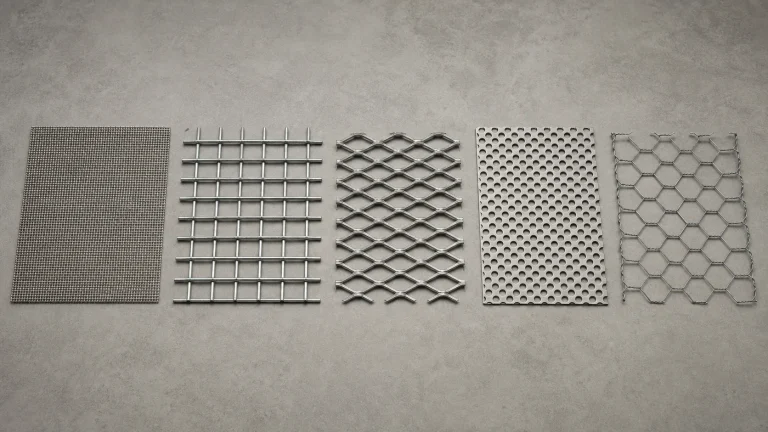
Start with the construction
Woven wire mesh is made by interlacing warp and weft wires. It includes plain weave, twill weave, Dutch weave, crimped mesh, and other constructions used for screening, filtration, protection, and industrial processing. Its opening geometry, flexibility, and surface profile depend on the weave and wire relationship.
Welded wire mesh joins crossing wires at intersections. It is supplied in rolls or rigid panels and is common in fencing, reinforcement, machine guards, racks, cages, and fabricated baskets. The contrast between welded rigidity and woven flexibility is explained in our welded versus woven wire mesh guide.
Other major product families include chain link fence mesh, twisted hexagonal wire netting, expanded metal, perforated metal, barbed and razor wire, wedge wire, knitted wire mesh, metal lath, gabion mesh, filter cloth, conveyor mesh belts, and decorative architectural mesh. Each family has its own joining method, edge condition, likely supply form, and inspection points.
Material and finish change the service limits
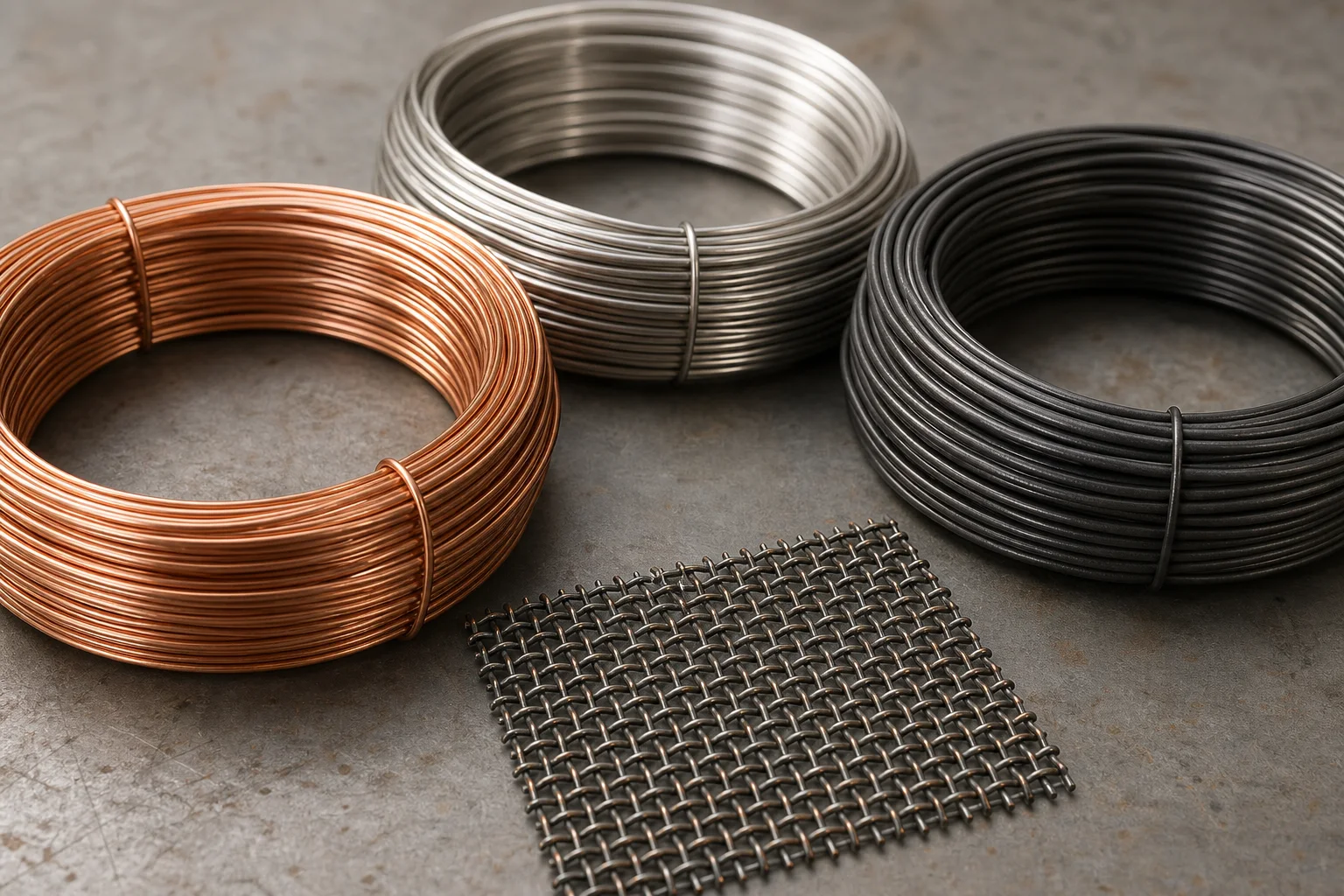
Low-carbon steel, galvanized steel, stainless steel, aluminium, copper alloys, nickel alloys, and selected specialty metals all appear in mesh products. The material alone does not tell the whole durability story. A buyer also needs to know whether steel is bare, pre-galvanized, galvanized after fabrication, zinc-aluminium coated, painted, or polymer coated; whether a stainless grade is specified; and whether cutting or welding will expose an edge after the finish is applied.
For a general guide, “galvanized mesh” is a starting description rather than a final requirement. The base wire, coating route, finished dimensions, service environment, and acceptable surface condition need to be controlled when corrosion resistance matters. The same discipline applies to material certificates and inspection records at receiving, covered in our wire mesh receiving inspection checklist.
Dimensions are a set of fields, not one number
The core fields vary by product type. Woven mesh may require mesh count, clear opening, wire diameter, weave, and width. Welded mesh usually needs opening, wire diameter, panel or roll size, weld condition, and edge treatment. Chain link needs mesh opening, wire diameter, height, selvage, coating, and the system hardware. Hexagonal netting needs mesh opening, wire size, twist construction, roll width, and finish.
Opening, pitch, wire diameter, and open area should never be assumed to mean the same thing. The correct measurement definition must be agreed before a supplier quotes or an inspector accepts product. A controlled request for those fields is the basis of a useful wire mesh RFQ.
Match the form of supply to the job
The same mesh can be supplied as a roll, sheet, panel, cut blank, framed screen, basket, cylinder, filter disc, fence system, or finished assembly. That affects handling, flatness, usable area, packing, freight, and installation. A flexible roll may be appropriate for field fencing; a machine guard may require a flat, framed panel; a filtration component may need controlled cut edges and traceability.
This guide begins a long product series rather than replacing product-specific guidance. For neutral, practical coverage of specifications, use cases, and quality questions, see our editorial approach or use the contact page to suggest a topic or correction.