
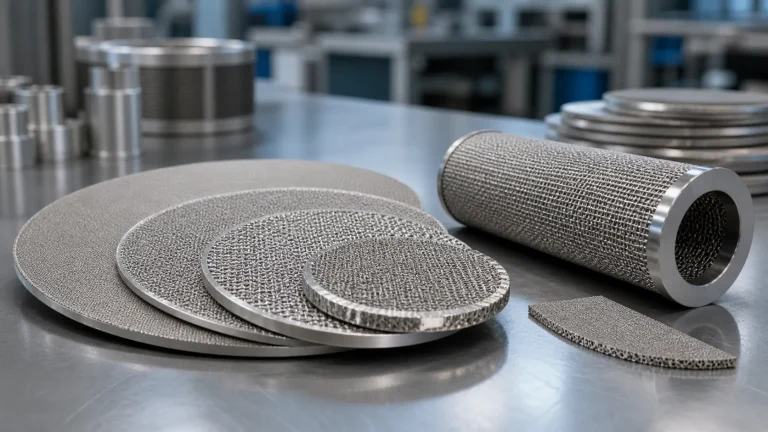
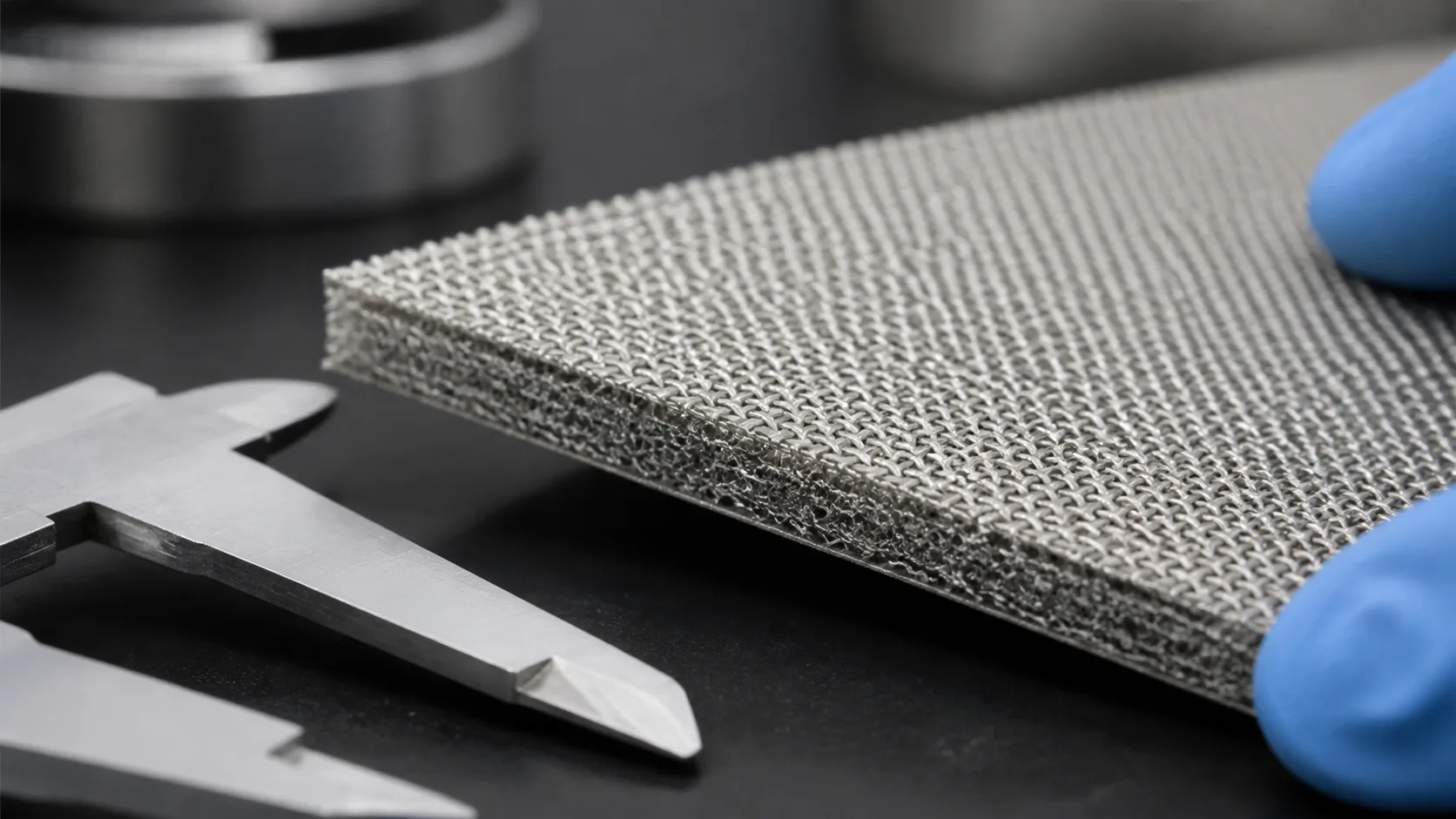
Sintered wire mesh is a porous metal material made by bonding selected layers of woven wire mesh through a controlled thermal process. The result is not merely several screens stacked together: the layers become a rigid laminate with a defined filtration face, supporting structure, and flow path. This combination is valued where cleanability, pressure resistance, repeatable geometry, and metallic construction are more important than the lowest initial media cost.
How the layered structure works
A common construction includes a fine filtration layer supported by one or more coarser woven layers. The fine layer controls the retained particle range; supporting layers help the laminate resist deformation and distribute flow. The exact stack, weave types, alloy, and bonding process depend on the intended duty. The starting point is still woven wire cloth, so it helps to understand the distinctions between plain, twill, and Dutch weaves before treating a sintered medium as a black box.
Because layers interact, a seller should not describe a sintered laminate only by one mesh count. Buyers need the supplier’s stated filtration rating or retention basis, material grade, thickness, permeability or pressure-drop data where relevant, and information on the test method used. “Fine filtration” is too vague for a process specification.
Where sintered mesh is used
Typical uses include polymer and chemical processing, hydraulic and lubrication filtration, gas distribution, catalyst retention, high-temperature service, and fabricated filter elements such as discs, cones, cylinders, and cartridges. Its strength is especially useful where a loose woven screen might deform, or where a fabricated element must retain a stable porous layer after welding, cutting, or repeated cleaning.
Application conditions drive material choice. Fluid chemistry, temperature, differential pressure, solids loading, required cleanliness, and cleaning method all influence whether stainless steel or another alloy is appropriate. A higher-grade material is not automatically the safer choice if its weldability, lead time, or compatibility has not been checked. For applications that use profiled slot media rather than layered cloth, compare the distinct construction in our wedge wire screen guide.
Selection: separate retention from flow
A filter medium is selected by balancing what it must retain against the flow it must pass. Finer retention generally raises resistance, especially as a cake builds on the surface. The operating pressure drop, viscosity, temperature, cleaning cycle, and acceptable change-out interval should be considered together. Ask whether the stated rating is nominal or absolute in the supplier’s terminology, and request enough supporting data to compare offers on the same basis.
It is also important to define the flow direction. Some constructions are intended to support the fine layer from one side. Reversing the installed orientation can make cleaning less effective or expose a delicate layer to conditions it was not designed to carry. The same RFQ discipline used for ordinary mesh applies here, but process data must be included: see how to write comparable wire mesh RFQs.
Fabrication and cleaning limits
Sintered mesh can be cut, formed, welded, framed, or incorporated into a housing, yet its porous face must be protected from blocked openings and thermal damage. Discuss the fabrication route early, including which surfaces may be welded and how the completed element will be cleaned. A filter that is technically cleanable in a laboratory may be impractical to clean safely in its installed position.
Cleaning methods may include reverse flow, ultrasonic cleaning, controlled solvent treatment, or other process-specific methods. The correct route depends on the contaminant and compatible materials; aggressive cleaning can harm seals, alter contamination, or push particles deeper into the medium. Establish the approved method with the process owner rather than relying on a generic cleaning promise.
Receiving and documentation
On receipt, verify the part number, alloy declaration, dimensions, thickness, weld or frame condition, orientation marks where supplied, and packaging cleanliness. Keep protective film or caps in place until assembly. For custom elements, retain inspection records and a sample or reference photograph, then compare later deliveries against that approved configuration. The broader receiving inspection checklist is a useful baseline, but filtration elements need additional process-specific checks.
In short, sintered wire mesh is chosen for a controlled porous structure rather than for a visual mesh appearance. A well-written specification identifies the duty, performance target, construction, fabrication interfaces, and cleaning plan before purchase—not after the element is already in service.