
“Galvanized wire mesh” is not a complete corrosion-protection specification. Zinc may be applied to wire before it is welded or woven, or to a fabricated mesh product afterward. Coating mass or thickness, surface preparation, weld condition, storage and the service environment all affect the purchasing decision. Buyers should therefore order a defined product and evidence, not a silver appearance.
Separate the coating route from required performance
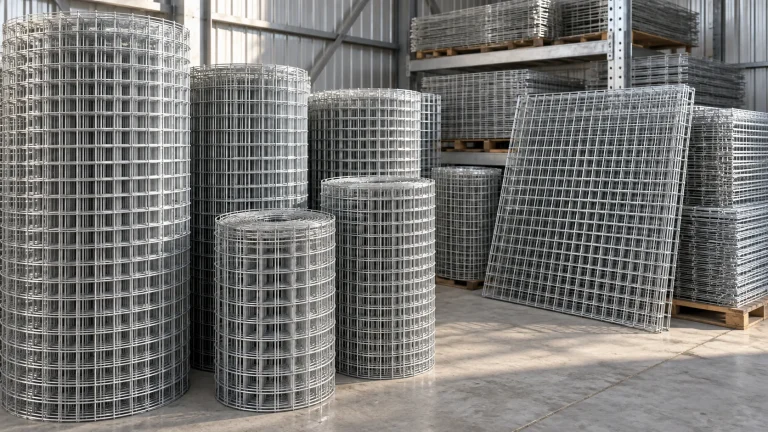
Galvanized-before-welding mesh is made from zinc-coated wire and then resistance welded. The welding operation heats and compresses the coating at each intersection, so weld areas can look different from the rest of the wire. Galvanized-after-welding mesh is fabricated first and then coated, allowing zinc to cover wires, cut ends and intersections as part of the finished panel or roll.
This distinction does not prove that every after-weld product has more zinc or a longer life than every before-weld product. Continuous wire coatings, batch hot-dip processes and other routes use different specifications and practical limits. The American Galvanizers Association explains why welding before after-fabrication hot-dip galvanizing lets zinc cover a fabricated structure, while noting how weld cleanliness and chemistry affect coating appearance.
Put measurable zinc requirements in the order
Ask for the applicable standard, product class, coating designation and minimum or average requirement exactly as the design needs them. A zinc mass in grams per square metre and thickness in micrometres are related through density, but should not be casually substituted without the governing method. Clarify whether the requirement applies to wire before fabrication or to the completed mesh.
Do not use the words heavy galvanized without a definition. Two quotations can use that phrase for materially different coatings. State base wire, nominal diameter, aperture, dimensions, coating route, coating requirement, test method and documents. The product-family questions in our wire mesh classification guide help keep construction and finish separate.
Welded and woven mesh need different attention points
For welded mesh made from coated wire, inspect intersections for excessive bare areas, cracking, loose zinc or corrosion products inconsistent with the agreed specification. Welding zinc-coated steel damages zinc at and around a conventional weld unless process and coating system account for it; AGA’s welding guidance explains the need to restore protection after such welding.
For woven mesh, crossing wires rub and deform during crimping and weaving. Check high points, selvages and cut edges, but evaluate them against the specified product standard rather than expecting a flat-sheet finish. For welded panels coated after fabrication, inspect drainage points, overlaps, sharp projections and areas where handling or stacking could damage coating.
Use visual inspection to find conditions, not thickness
Appearance can reveal uncoated areas, handling damage, heavy runs, sharp points, inclusions, white storage stain or early red rust. It cannot reliably tell coating thickness. Different steel chemistry and cooling conditions can produce bright, dull or mottled zinc surfaces. Acceptance depends on the governing specification and intended use, not whether every panel has identical colour.
AGA’s hot-dip galvanized finish guidance emphasizes corrosion protection and intended use when evaluating finish. That resource concerns after-fabrication hot-dip galvanizing; buyers should use the correct standard for continuous galvanized wire or another coating route.
Plan coating-thickness measurements carefully
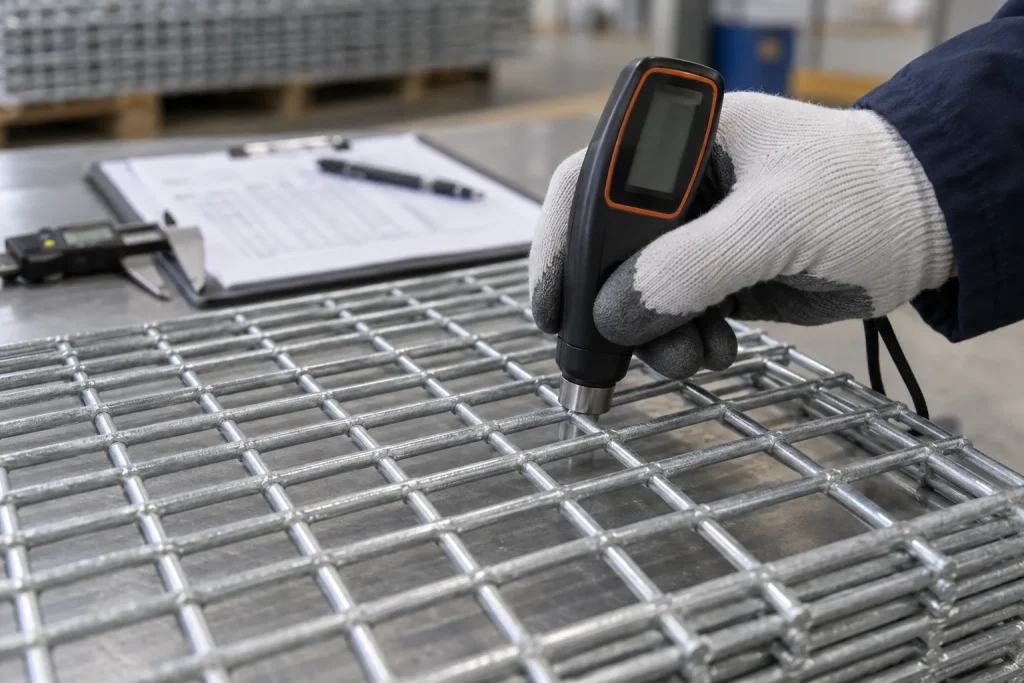
Magnetic gauges provide a common nondestructive method on suitable zinc-coated steel, but wire curvature and small diameters can affect probe seating and readings. Confirm that instrument, probe and calibration approach suit the product. Take readings at dispersed representative locations rather than selecting only the easiest area. Record gauge identification, calibration check, location and individual results.
The AGA notes in its coating-thickness overview that magnetic gauges are widely used and readings should be dispersed. It also ties acceptance to the applicable material category and specification. For fine mesh, laboratory mass testing or supplier process records may be more appropriate than unreliable field readings; settle this before purchase.
White storage stain is a logistics warning
Fresh galvanized surfaces kept wet with limited airflow can develop white corrosion products. Prevent this by storing rolls and panels dry, ventilated and raised from standing water, with packaging that does not trap condensation. Separate stacked items as required and inspect soon after arrival. Do not assume a wet bundle will recover simply because the steel is zinc coated.
Record the extent and photograph affected areas before cleaning or disposition. Light surface deposits and severe attack are not equivalent, and the correct action depends on specification and remaining coating. Red rust, widespread coating loss or wet-packed material needs prompt supplier review. The lot-control process in our receiving inspection checklist helps preserve evidence.
Define repair and cut-edge treatment
Panels may be cut, drilled or welded during installation. Each action can expose steel or damage surrounding zinc. Project documents should state whether field modification is permitted and identify approved repair system, surface preparation, required thickness and inspection. Touch-up paint should not be selected by colour alone, and repaired areas should be traceable where records are required.
For fabricated assemblies, check compatibility among mesh, frames, fasteners and dissimilar metals. Water traps and crevices can defeat an otherwise substantial coating. If mesh is powder coated over zinc, specify pretreatment, adhesion and finished-film requirements as a combined system rather than accepting two unrelated claims.
A practical receiving record
The report should identify supplier, purchase order, lot, dimensions, coating designation and documents. Add photographs of labels, general finish, weld or weave details and damage. Record the sampling plan and all measurements with locations. Keep rejected material separated until a documented concession, repair or return decision is made.
When comparing bids, require suppliers to state the actual coating route and every deviation from the requested zinc requirement. Our RFQ comparison guide provides a useful format. A traceable coating specification cannot guarantee unlimited service life, but it gives the buyer a measurable acceptance basis and a stronger starting point for maintenance decisions.