
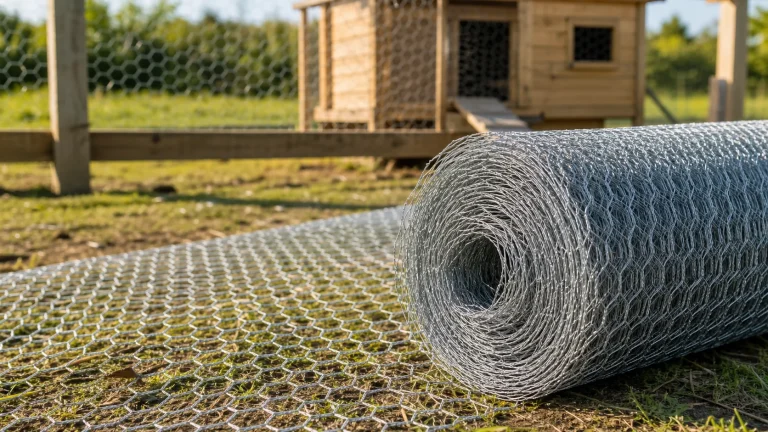
Hexagonal wire netting is a flexible mesh made by twisting wire into repeated six-sided openings. It is often called chicken wire, but that familiar name covers only part of its use. Depending on wire size, opening, finish, and construction, hexagonal netting can serve poultry enclosures, garden barriers, plaster support, protective wrapping, and stone-filled erosion-control systems.
What makes hexagonal netting different
The defining feature is a twisted-wire hexagonal opening. This construction is flexible, light relative to many rigid panels, and easy to supply in rolls. It should not be confused with chain link, which forms diamond openings, or welded wire mesh, which joins wires at intersections. The wire mesh classification guide explains why construction must be identified before dimensions are compared.
Common choices include ordinary twist and reverse-twist forms, with variations in mesh opening, wire diameter, roll width, roll length, and edge treatment. These fields control containment ability, handling, and the way the material behaves during installation.
Match material and opening to the intended use
For a small poultry enclosure, the opening should be chosen around the size and behavior of the animal to be contained or excluded; it should not be chosen from a product name alone. A garden barrier may prioritize easy handling and corrosion resistance. A plaster-support or protective-wrap use may emphasize attachment and finish. Heavy stone-containment work calls for a product designed and specified for that structural application, not an ordinary light poultry netting roll.
Galvanized finishes are common. Where an additional polymer coating is specified, identify whether dimensions refer to the base wire or finished wire, and record the finish condition expected after handling. These are exactly the assumptions that should be visible in a wire mesh RFQ.
Poultry, garden, and protective applications
Hexagonal netting is often used as a light enclosure or barrier because it can be cut and fixed around timber or metal framing. Good installation still depends on sound posts, sufficient tension, protected cut ends, and a suitable lower-edge detail. It is not automatically a high-security fence or a predator-proof system; those needs may require different mesh, smaller openings, heavier wire, or a complete fence design.
The same habit of treating mesh as a system applies to larger boundaries. Chain link, for example, relies on terminal posts, tension bars, rails, and ties in addition to the fabric; see the chain link fence mesh guide for that contrast.
Stone containment and erosion-control mesh
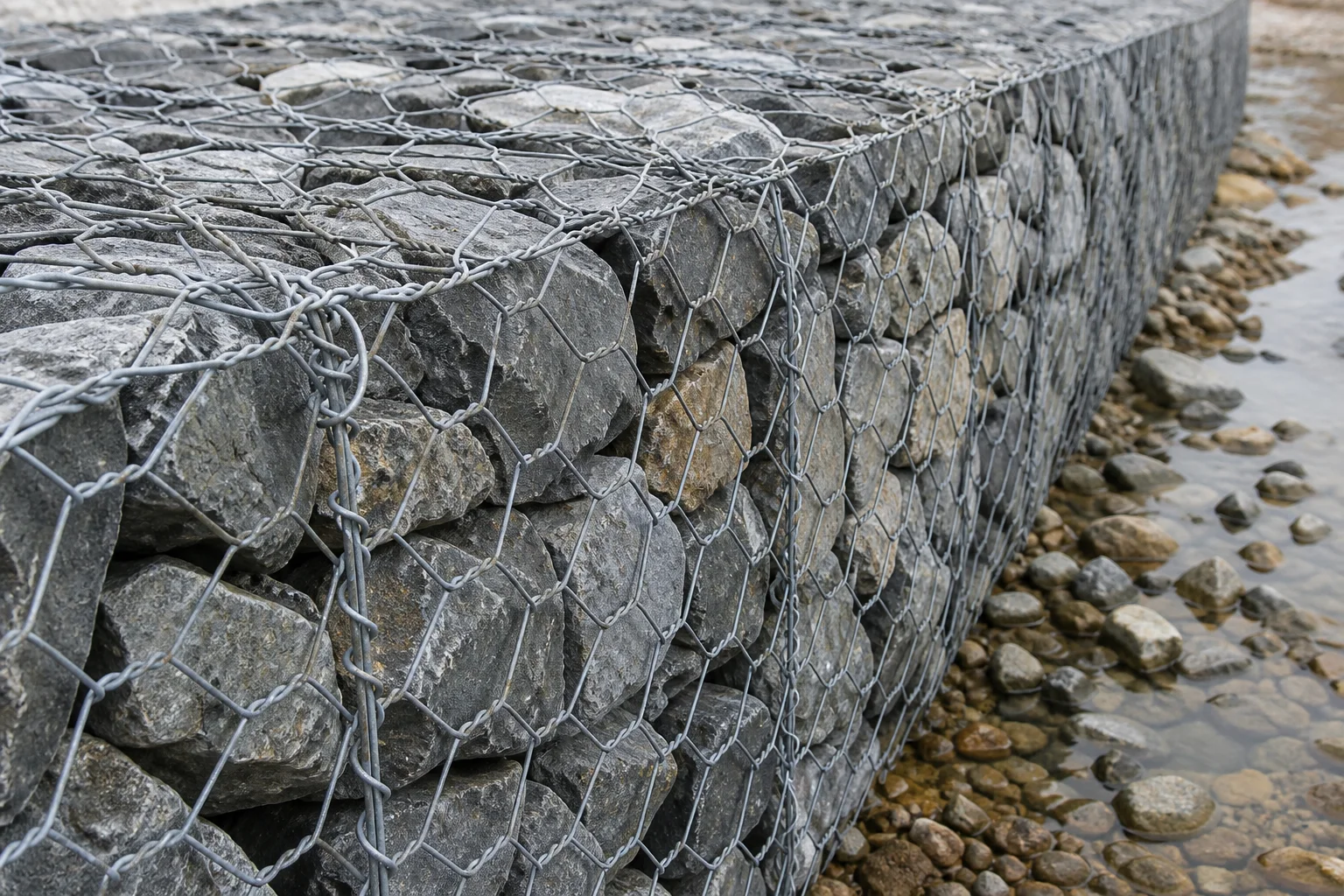
Heavier hexagonal mesh can be used to contain stone in suitable gabion or mattress systems. Its performance depends on the specified mesh construction, coating, lacing or fastening system, stone grading, geometry, foundation conditions, and hydraulic or geotechnical design. The mesh is one component of an engineered assembly, so project-specific design criteria must control selection.
Receiving and handling checks
At receipt, confirm the roll label, opening, finished wire size where required, finish, width, length, edge condition, and packing condition. Check for crushed roll ends, damaged coating, loose twists, or material mixed with a different specification. Our wire mesh receiving inspection checklist provides a repeatable documentation process.
Hexagonal wire netting is simple in form but broad in application. Use the contact page to suggest a future product topic or a documented correction.