
Knitted wire mesh is made from continuous metal filaments formed into interlocking loops rather than woven at right angles. The open, spring-like structure can be supplied as a roll, compressed into a pad, shaped into a gasket or cushion, or installed as a mist-elimination element inside process equipment. Its best-known industrial form is the wire-mesh demister pad, which helps remove entrained liquid droplets from a gas stream.
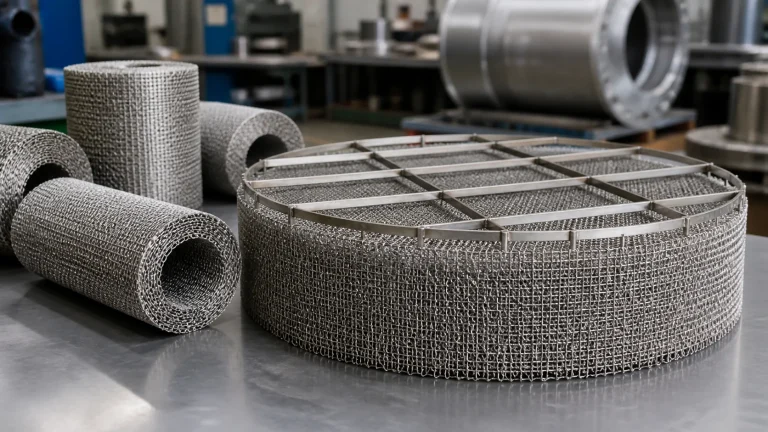
From knitted roll to demister pad
The loops in knitted wire mesh create a high void volume and many small surfaces. When material is compressed into a pad, the density and thickness can be adjusted for the target separation duty. A demister pad is normally held within a vessel or frame by support grids. Gas passes through the pad; droplets strike or follow the wire surfaces, coalesce into larger drops, and drain when the vessel design provides a suitable path.
This is not the same mechanism as particle screening. A woven wire mesh normally uses defined openings to classify or retain solids, while a knitted pad promotes droplet capture and coalescence in gas-liquid service. The distinction is central to selection: do not specify a demister by mesh count alone.
What controls separation performance
Performance depends on pad density, wire diameter, material, pad thickness, gas velocity, droplet-size distribution, liquid properties, fouling tendency, vessel geometry, and drainage. A pad that is too open may not capture the intended droplets effectively; one that is too dense can impose excessive pressure drop or become prone to flooding. The operating envelope should therefore come from the separation process, not from a product photo or an assumed “standard” density.
High gas velocity can re-entrain captured liquid or create a large pressure loss. Sticky liquids, solids, corrosive chemistry, and pressure fluctuations can change what is practical. For difficult services, process designers may consider alternate internals or combine functions. For example, profiled media such as wedge wire screens solves a different separation problem and should not be treated as a drop-in demister substitute.
Materials and construction details
Stainless steel is common where corrosion resistance and temperature capability are needed, but the proper alloy depends on the service environment. Other metal materials may be selected for chemical compatibility, weight, or cost. The pad can be circular, rectangular, segmented, or shaped to a vessel opening. Edge treatment, grid design, ties, frames, lifting features, and access constraints should be clarified when the element is large or must be removed for maintenance.
For an RFQ, state vessel or frame dimensions, allowable thickness, material requirement, intended orientation, process conditions, target performance if available, and all required support components. Include whether the pad will be supplied as one piece or sectors. This makes supplier quotations easier to compare and follows the same basic discipline in our wire mesh RFQ guide.
Inspection before installation
Check the supplied pad against the drawing for outside diameter or width, thickness, section count, material identification, grid attachment, and any locating features. Look for crushed areas, loose wire, broken ties, sharp projections, and contamination. Confirm that sections fit their intended orientation and that the support grid is not bowed or damaged. A pad can look acceptable on a pallet but fail to seat properly in the vessel.
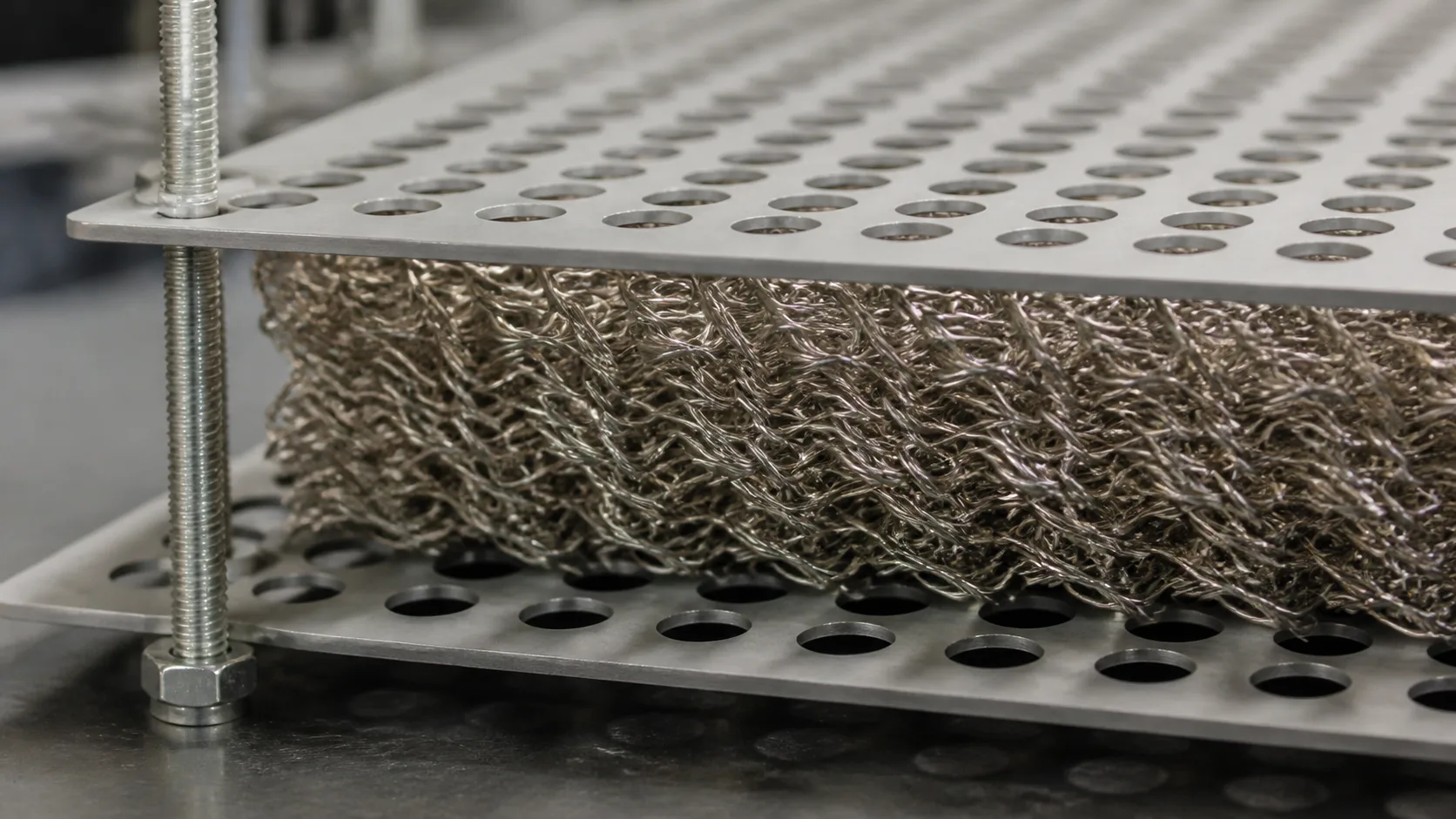
Receiving checks should be recorded before installation, especially for custom-built pads. The general approach in the mesh receiving inspection checklist applies: match paperwork, inspect condition, measure critical features, and separate discrepancies before use. Process equipment may also require cleanliness controls that go beyond ordinary mesh shipping practice.
When knitted mesh is the right choice
Knitted wire mesh is useful when a resilient, open metallic structure is needed for coalescence, cushioning, contact, or mist elimination. It is not automatically the correct answer for every “filter” requirement. Define whether the task is liquid-droplet removal, solid-particle retention, support, sealing, or vibration control, then select the construction around that function.
A demister pad performs as part of a system: the pad, support grids, vessel internals, gas rate, liquid drainage, and maintenance plan all work together. Purchasing the pad with a clear process brief and a verifiable dimensional drawing is the most reliable route to a usable result.