
Two suppliers can offer “20 mesh” and deliver cloth with different openings. Both descriptions may be correct: mesh count sets the repeat spacing, while wire diameter determines how much of that spacing is metal. To compare square woven mesh properly, specify count, wire diameter and aperture together. Open area adds another useful measure, but it is a geometric value rather than a promise of filtration efficiency or flow capacity.
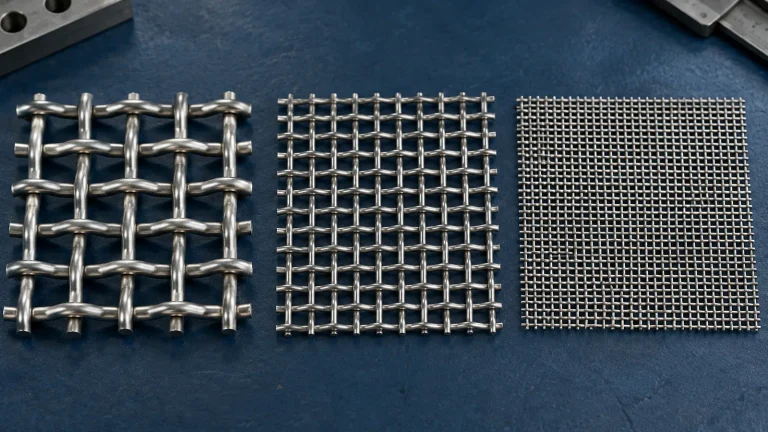
The four dimensions that belong together
For regular square woven cloth, mesh count M is the number of repeating pitches per linear inch. Pitch p is the centre-to-centre distance between adjacent parallel wires. Wire diameter d is the diameter of the wire, and aperture a is the clear opening between wires. With consistent units, the basic relationship is p = a + d. If count is per inch and the dimensions are in millimetres, p = 25.4 / M.
The Universal Wire Cloth technical data sheets present the corresponding mesh-opening and open-area formulas. These relationships describe a regular geometry. Actual cloth still has manufacturing variation, crimp and an inspection specification. The equations are useful for checking an offer, but do not establish that a shipment meets its tolerances.
Calculate aperture from mesh count and diameter
For square mesh, use a = 25.4 / M − d, with d and a in millimetres. Consider a proposed cloth of 20 mesh with 0.40 millimetre wire. The pitch is 25.4 / 20 = 1.27 millimetres. Subtracting the wire diameter gives a nominal opening of 0.87 millimetres, or 870 micrometres. This is a calculated example, not a claim that every commercial 20-mesh product uses that wire.
Now keep the count at 20 but increase wire diameter to 0.50 millimetres. The pitch is unchanged, so aperture becomes 0.77 millimetres. The mesh number did not change; the opening narrowed by 0.10 millimetres. If the process depends on passage through the opening, accepting the second cloth solely because its mesh count matches would miss a meaningful difference.
Calculate percentage open area
For the same ideal square geometry, open area is 100 × [a / (a + d)]². The square appears because an opening has both a width and a height. For 20 mesh with 0.40 millimetre wire, this gives 100 × (0.87 / 1.27)² = approximately 46.9%. With 0.50 millimetre wire, the calculation becomes 100 × (0.77 / 1.27)² = approximately 36.8%.
| Count per inch | Wire, mm | Aperture, mm | Open area |
|---|---|---|---|
| 20 | 0.40 | 0.87 | 46.9% |
| 20 | 0.50 | 0.77 | 36.8% |
| 40 | 0.25 | 0.385 | 36.8% |
The last two examples also illustrate a useful limit: similar open-area percentages can accompany very different apertures. A screen with a 0.385 millimetre opening is not interchangeable with one having a 0.77 millimetre opening merely because their geometric free-area fractions match. Keep the individual dimensions visible in the purchasing record.
Work backwards from a required opening
If the required aperture and wire diameter are known, M = 25.4 / (a + d). An illustrative requirement of 0.50 millimetre aperture and 0.25 millimetre wire gives approximately 33.87 pitches per inch. That arithmetic does not guarantee that a stock item exists at exactly those dimensions. Ask the supplier to identify the nearest available construction and explicitly state any change in wire, opening or tolerance.
The appropriate choice may be a custom weave, a nearby standard construction or a revised process requirement. Do not silently round the count and leave the drawing unchanged. The intended function determines which dimension can move. For more on how interlacing changes the product family, see our guide to woven mesh structures.
Use units and counting methods consistently
One millimetre equals 1,000 micrometres; one inch equals 25.4 millimetres. Convert first, then calculate. A diameter quoted as 0.010 inch is 0.254 millimetre, not 0.10 millimetre. A supplier’s wire gauge number is also insufficient unless the gauge system is identified. Asking for an actual metric diameter makes international comparisons easier.
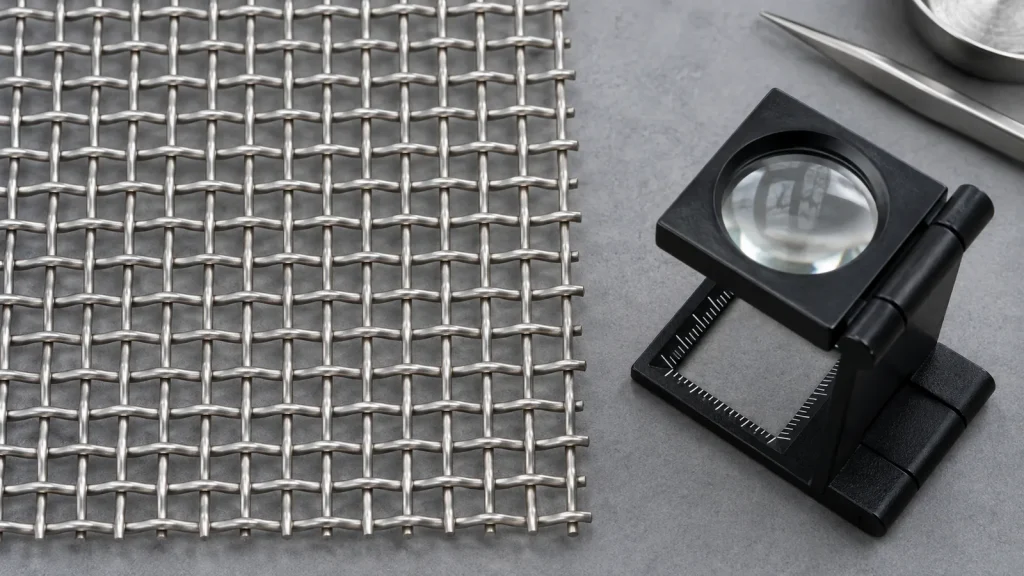
When inspecting a sample, counting over several pitches can reduce the influence of one reading error. Keep track of intervals rather than assuming that the number of visible wire lines equals the number of pitches. Fine meshes require suitable optical equipment and a defined procedure; a handheld ruler is not an adequate acceptance method for every cloth. Use our receiving inspection checklist to connect the measurement record with the lot and approved specification.
Where these formulas stop being the right model
A rectangular weave has separate dimensions in the two directions. Its ideal free-area fraction is [a₁ / (a₁ + d₁)] × [a₂ / (a₂ + d₂)], multiplied by 100 for a percentage. A square-mesh equation should not be applied to a rectangular cloth by taking an unexplained average count. Record each axis independently, including its orientation in the installed panel.
Dutch filter weaves, multilayer media, knitted mesh and profiled screens need descriptions appropriate to their construction. In particular, the straight-through square opening model does not describe the complete pore path of sintered wire mesh. Neither an advertised filtration rating nor a standard test-sieve designation should be reverse-engineered from a casual mesh number without the supplier’s definitions and test basis.
Open area is only one input to a flow decision
Actual pressure loss and throughput depend on more than projected free area. Fluid properties, velocity, thickness, support structures, fouling and the installed arrangement also matter. A calculated percentage can help screen candidate constructions; it does not supply a pressure-drop curve. Request relevant operating data when the application has a defined flow or differential-pressure limit.
A useful quotation line therefore lists construction, alloy, count in both directions, wire diameters, nominal apertures, tolerances, roll or panel dimensions and the required test documentation. Mark calculated values as calculated, and separate them from measured acceptance results. Our RFQ comparison guide explains how to keep supplier alternatives visible. This allows a buyer to decide whether a proposed substitution is acceptable before it reaches production.