
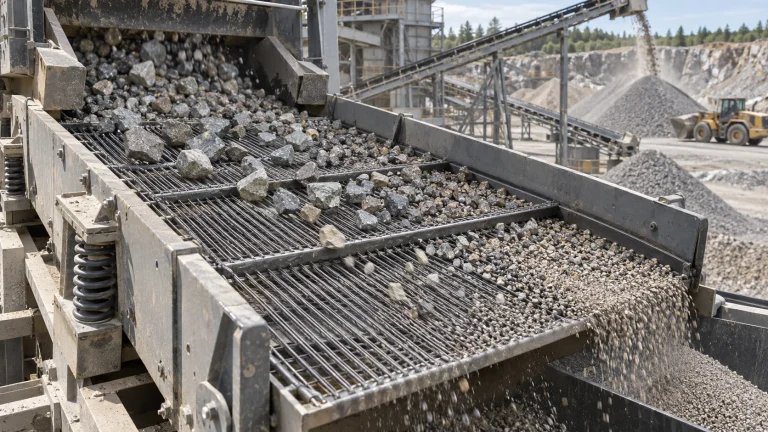
Self-cleaning wire screen media is designed for screening duties where conventional woven cloth repeatedly blinds, pegs or carries excessive fines into the retained product. Its wires can move more independently than the intersections of a standard woven screen, helping near-size particles release instead of remaining locked in an opening. That mechanism can improve useful open area during operation, but it does not make one pattern suitable for every feed or deck position.
How the construction differs from woven wire cloth
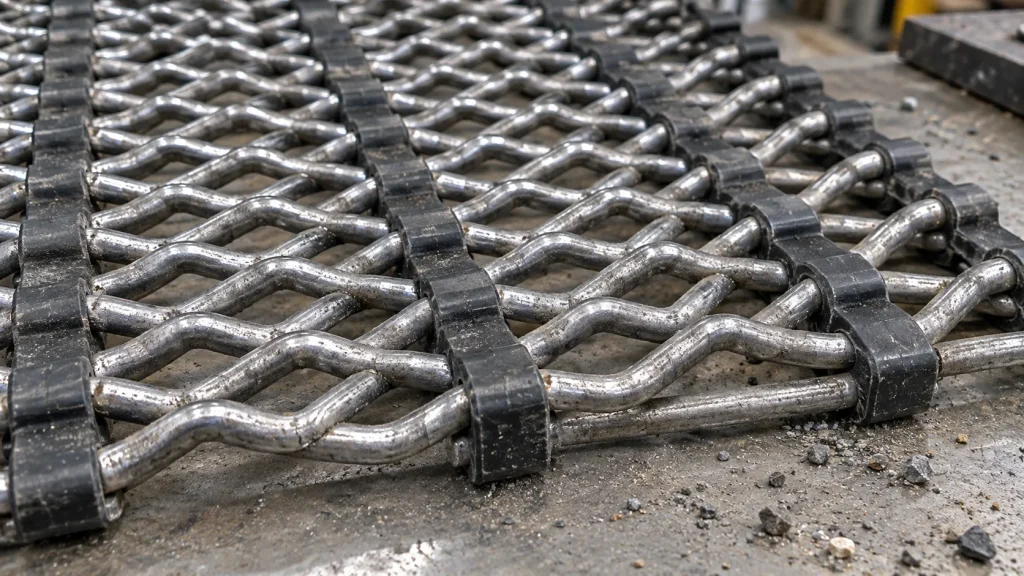
Conventional square woven screen cloth locks warp and weft wires together at every crossing. Self-cleaning media commonly uses crimped wires held at intervals by polyurethane strips, so sections of wire can vibrate under material contact. MAJOR’s high-vibration wire screen description explains this independent-wire principle and its role in reducing blinding and pegging. The product is therefore not simply a looser version of ordinary woven mesh.
The distinction matters when ordering replacements. A maintenance team must identify the deck, fastening arrangement, screen curvature, support spacing and flow direction rather than request only an opening size. For background on conventional interlaced constructions, compare our crimped wire mesh screen guide.
Choose the opening pattern around the separation objective
Manufacturers use different names, but common families include square-like openings for controlled sizing, elongated openings for more open area, and fine-screening arrangements intended to resist blinding. MAJOR describes D, S and T patterns for different material shapes and sizing priorities in its opening-style guidance. Treat these as manufacturer-specific examples, not universal industry designations.
Start with the product specification. Record the required cut point, acceptable oversize and undersize, particle shape, moisture range, clay or organic contamination, feed rate and permitted carryover. A highly open pattern may increase passage but allow more elongated particles through. A more controlled opening may protect sizing accuracy but offer less relief from difficult feed. Agree the tradeoff using samples or plant data, not a brochure alone.
Map impact and loading across the deck
The feed end receives the greatest impact and bed depth. It may need heavier or doubled wires, a protective impact zone, or another media type. Farther down the deck, thinner wires or a more open construction may improve stratification and fines removal. Installing one specification over the full length is convenient, but can sacrifice either wear life at the feed end or capacity at the discharge end.
Create a deck map that records panel position, opening, wire construction, fastening and installation date. Also record tonnes processed and the reason for replacement. This turns screen selection into a controlled trial: the team can compare cost per tonne, product quality and stoppages rather than judging only purchase price or calendar life.
Installation details can decide whether the trial succeeds
Follow the screen and equipment manufacturers’ instructions for tension, support bars, side sealing and fastening sequence. Check that protective rubber is present where specified and that the media seats consistently on the supports. Incorrect crown, insufficient tension or loose fasteners can allow movement that damages wires and hooks. Excessive tension can distort the intended opening or overload components.
Confirm the installed direction before startup; some elongated or directional patterns are not symmetric in service. Use the site’s safe commissioning procedure to check clearance. After a controlled initial run, stop under the site’s isolation procedure and inspect seating, fasteners, side gaps and early wear. Never adjust operating screening equipment.
Diagnose blinding, pegging and contamination separately
Blinding usually describes fine or moist material coating or blocking openings. Pegging describes near-size particles wedged in individual openings. Contamination can arise when unwanted fines remain in the oversize product even though apertures are clear. Each symptom suggests different checks, so photographs and product samples are more useful than a note saying only “screen blocked.”
If blinding persists, review moisture, clay content, bed depth and whether the chosen pattern can move freely. For pegging, compare actual particle shape and size distribution with the aperture. For contamination, inspect side seals, damaged areas, orientation and feed distribution before selecting a larger opening. The geometrical relationship among aperture, wire and open area is explained in our mesh count and open area guide.
Inspect wear as a pattern
Look for localized polishing, flattened wire crowns, broken strands near supports, damaged polyurethane strips and openings that have spread. A narrow wear band can indicate uneven loading or a failed support rather than inadequate alloy. Compare the feed and discharge ends and both sides of the deck. Mark damage locations and retain a representative removed section when investigating repeated failures.
Incoming panels should be checked for ordered dimensions, pattern, hook or modular fastening details, transport damage and traceable identification. Our wire mesh receiving checklist provides a record structure. Store sections as directed so hooks and flexible strips are not distorted before installation.
Build a purchase specification that supports comparison
An RFQ should include machine make and model, deck position, panel dimensions, fastening system, support spacing, required aperture and pattern, wire material, feed description, hourly throughput and the current problem. State whether the priority is tighter sizing, increased capacity, reduced cleaning or longer service life. Attach a deck drawing and photographs when dimensions are difficult to describe.
Ask each supplier to identify every assumption and the expected trial method. Do not compare offers as equivalent when one changes opening shape or wire construction. The quotation table in our wire mesh RFQ guide helps keep departures visible. A documented trial, followed by inspection and product sampling, is the safest way to decide whether self-cleaning media solves the actual plant constraint.