
A cylindrical wire mesh filter cartridge is an assembly, not a sheet of cloth rolled into a tube. The filter medium, support core, seam, end caps and sealing connection all affect whether the element fits its housing and retains particles in service. This guide covers the purchasing decisions that are easy to miss when a quote lists only material, mesh count and overall length.
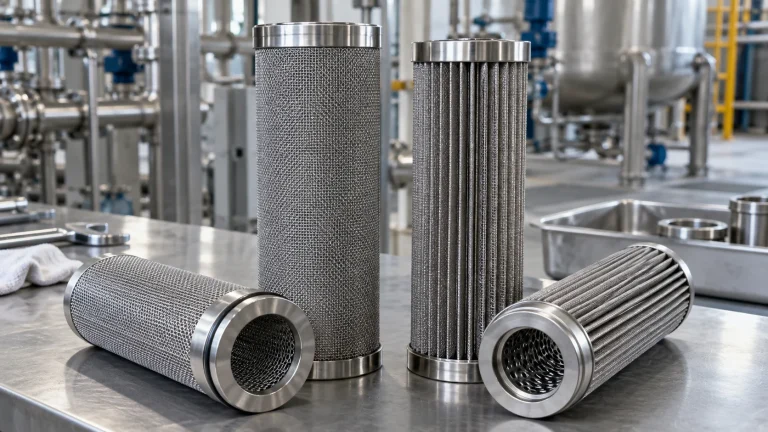
Start with the job the element must do
Record the fluid, contaminants, operating temperature, normal and maximum flow, allowable clean pressure drop, maximum differential pressure and cleaning procedure. Identify the installed housing and the direction of flow. A filtration rating needs its test basis: a nominal rating, an absolute rating and a woven-cloth aperture are not automatically equivalent.
For a coarse protective strainer, plain woven mesh may be sufficient. More demanding separation may use a finer weave or sintered multilayer medium. Our weave guide explains how interlacing changes the cloth, while the sintered mesh guide covers bonded layers and their different cleaning behavior.
Choose the media construction and rating
Ask the supplier to state the precise media layers, alloy, nominal or measured aperture, filtration rating and test method. Wire diameter and count alone may be insufficient for a Dutch weave or multilayer cartridge. If a fine membrane is supported by coarser mesh, identify each layer and which side faces incoming flow. Pleating increases available media area in a given envelope, but it adds fold geometry and support requirements.
Pall’s sintered mesh cartridge specification provides one example of stainless woven wire bonded at contact points and pleated into a cartridge. Its stated performance belongs to that product. Do not transfer a vendor’s filtration rating or allowable pressure to an untested lookalike.
Support cores and pleats carry mechanical loads
Pressure acting across a fine mesh cylinder can deform unsupported media. A perforated tube, coarse wire backing or other support may be needed depending on flow direction and pressure difference. If the cartridge is backwashed, reverse pressure can load the media and seams differently. State both normal and reverse limits in the inquiry.
Pleat depth and spacing affect accessible area and cleanability. Closely packed pleats can trap deposits where cleaning fluid does not reach. An apparently larger pleated surface therefore does not guarantee more useful dirt capacity for every contaminant. Ask for a flow versus differential-pressure curve and the test fluid or conditions used to obtain it.
Inspect the seam and end connections
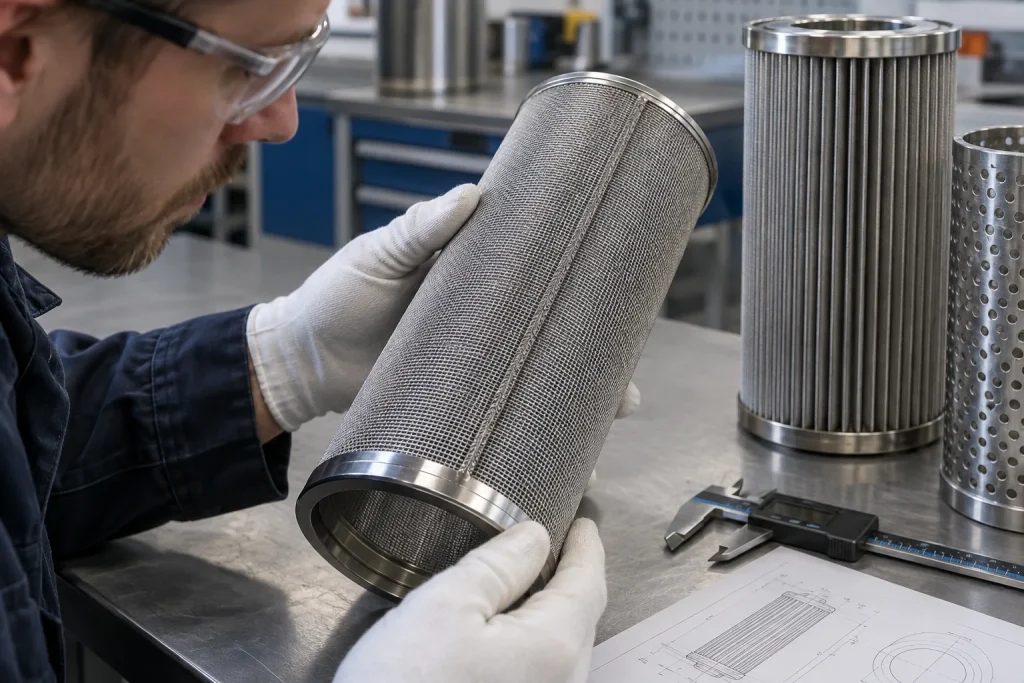
A longitudinal seam can be welded, mechanically joined or fabricated by another approved process. Its continuity matters because an open seam creates a bypass path. Check that the joint does not shed burrs or obstruct the housing. On a pleated element, inspect the transition from pleated pack to end cap; cracks or incomplete attachment there can defeat a sound mesh medium.
Specify end-cap style, outside diameter, overall length, sealing land, gasket material, open or closed ends and any threaded, bayonet or sanitary connection. Two cartridges with the same body dimensions can be incompatible if the end connection differs. Request an approved assembly drawing and a housing fit check before ordering a large replacement lot.
Material compatibility includes every component
Stainless grades such as 304 and 316 may both be offered, but exposure to process chemistry, cleaning chemicals and stagnant deposits should drive the choice. End caps, support core, weld filler and fasteners should be included in the bill of materials rather than assumed to match the outer mesh. Our 304 versus 316 mesh guide provides the material selection questions.
Where contamination matters, request the surface condition and an appropriate cleaning and packaging procedure. A stainless appearance does not prove the alloy, a finished weld condition or cleanliness. Agree whether certificates identify the starting wire, the fabricated assembly or both, and how the cartridge lot can be traced after installation.
Design cleaning as part of selection
Metal cartridges may be cleaned and reused when their design and process allow it, but an aggressive cleaning method can deform fine wire or damage a bonded layer. State whether the method uses backwash, solvent, ultrasonic cleaning or controlled manual washing and seek the element maker’s limits. The required post-cleaning test may be visual inspection, differential-pressure comparison or a defined integrity check.
Keep a baseline clean differential pressure for a new element in known conditions. A rise in pressure can indicate loading, but it may also reflect viscosity, temperature or flow changes. A surprisingly low pressure drop after cleaning can be a warning of bypass, so neither direction should be interpreted without a consistent operating record.
Receiving and service-life checks
At receiving, match part number and revision to the drawing, then inspect media damage, seam continuity, end-cap geometry, gasket condition, cleanliness and transport protection. For fine elements, avoid pressing tools or fingers into the mesh. Quarantine damaged parts and document the finding before cleaning or reshaping them.
Track installation date, process duty, clean and dirty pressure, cleaning cycles and retirement reason. A cartridge should be replaced when it can no longer meet its agreed separation and mechanical requirements, even if it still looks intact. Use our receiving checklist for lot evidence and the RFQ guide to compare offers on the same media and connection basis.
Questions for the next supplier quotation
Ask what rating is claimed, how it was tested, the recommended maximum differential pressure in each direction, the housing interface drawing, and the number of qualified cleaning cycles if a reuse claim is made. Request a sample for fit and an agreed trial protocol. These details prevent a superficially similar mesh cylinder from being substituted for a qualified filter element.