
Welded wire mesh and woven wire mesh can both be described by opening size, wire diameter, material, and finish. That similarity makes it easy to compare them as if they were interchangeable. They are not. The joint construction changes how a mesh carries load, responds to cutting and forming, holds its geometry, and performs in a screening or filtration process.
The useful selection question is therefore not “which mesh is better?” It is which construction matches the load path, flow requirement, fabrication route, and acceptance criteria of the finished job. This guide provides a practical way to make that distinction before requesting samples or quotes.
Start with how the wires meet
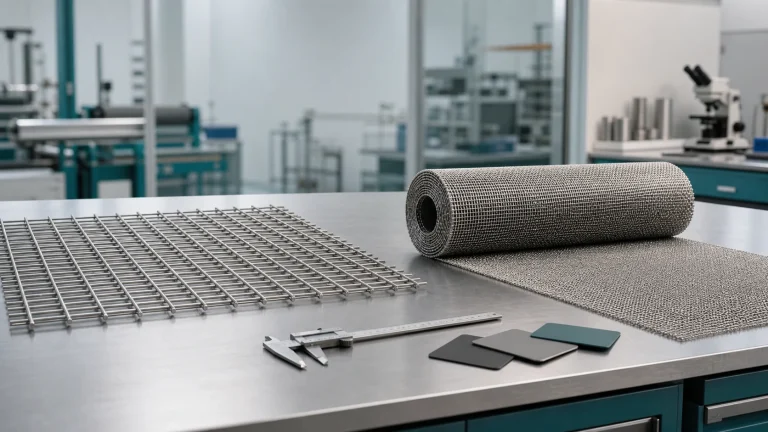
In welded wire mesh, longitudinal and cross wires are joined at their intersections. The result is a stable grid that normally keeps its opening geometry well when handled as a panel, cut sheet, or supported roll. It is often a sensible starting point when the mesh needs to resist localized handling, stay square in a frame, or act as a guard, reinforcement layer, divider, basket, or fence component.
In woven wire mesh, wires pass over and under one another. Depending on the weave and wire combination, the construction can offer fine openings, different surface characteristics, controlled flexibility, and a broad range of screening or filtration possibilities. It is commonly evaluated for separation, sieving, protective screens, insect control, architectural infill, and applications where material needs to conform to a shaped support.
Neither construction removes the need to define the actual material. The Anping cluster sourcing guide explains why a deep supplier base can make many formats easy to source, but a regional supply base is not a material specification. Confirm the grade, coating system, dimensions, and production route for the specific item being purchased.
Choose welded mesh when shape retention is the first requirement
Welded mesh usually deserves close consideration when the mesh must remain flat or square after routine handling. Typical examples include machine guards, animal enclosures, storage partitions, concrete reinforcement formats, fabricated baskets, protective grilles, and framed fence panels.
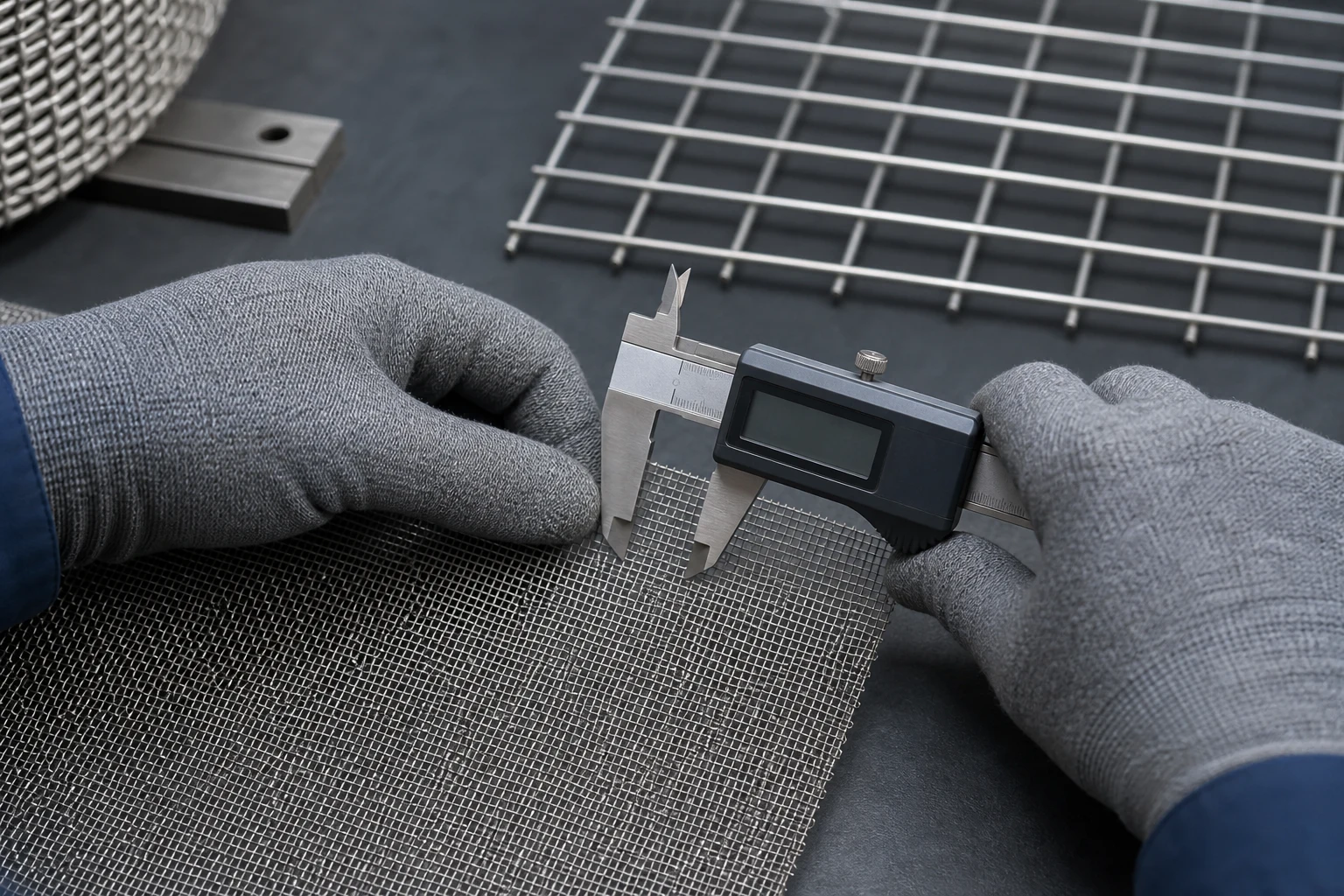
The key inspection questions are practical. Is the specified opening measured centre-to-centre or clear opening? What is the allowed wire-diameter variation? How much weld strength is required for the intended handling? Will cut edges be exposed, capped, welded into a frame, or coated after fabrication? A panel can look regular while still having issues with flatness, loose intersections, coating damage, or inconsistent edge treatment.
Where corrosion resistance matters, the sequence is also important. A buyer should distinguish between bare wire welded before coating, coated wire welded after coating, stainless construction, and any secondary finish. Each route can affect appearance, exposed weld areas, dimensional build-up, and repair expectations after cutting.
Choose woven mesh when opening behavior and conformity matter
Woven mesh is often the better discussion when the central requirement is a controlled opening, a fine screen surface, or a material that must sit over a curved or replaceable support. The application may care about particle passage, retention, free area, surface finish, drainage, airflow, or interaction with a downstream process rather than panel rigidity alone.
That does not mean woven mesh is automatically “more precise.” Precision comes from the agreed combination of aperture, wire diameter, weave pattern, tension, width, length, flatness, and inspection method. A quote that only says “stainless woven mesh” leaves too many variables open for comparison.
For technical requirements, define whether the acceptance criterion is mesh count, clear aperture, nominal wire diameter, or a functional test. These measures are related but not identical. A sourcing team should decide which one controls the application and make that measurement method part of the purchase record.
Compare the load path, not only the price per square metre
Price comparisons become misleading when one quotation covers a rigid welded panel and another covers a flexible woven roll with a similar nominal opening. The material yield, joining work, coating route, packing method, and fabrication loss may be completely different.
For a guard or partition, ask what happens when the mesh is lifted by one edge, cut into a small panel, or attached to a frame. For a screen or filter support, ask what happens under flow, cleaning, vibration, and repeated replacement. For a fence, ask whether posts, clips, tensioning, gates, and edge finishing are part of the same system or separate supply items.
This is also where the industry’s move toward more demanding applications becomes relevant. Our analysis of precision materials and digital trade in Anping shows why the conversation increasingly extends beyond commodity rolls into material control, process records, and application-specific performance.
Turn the selection into measurable acceptance criteria
The simplest way to avoid a vague mesh order is to translate the application into a short list of checks. State the material and finish first. Then define opening, wire diameter, width or panel size, tolerances, edge condition, and packing. Add a separate clause for the characteristic most likely to cause failure: weld integrity, flatness, aperture consistency, corrosion performance, free area, or a functional screening result.
Samples should represent the production route, not just the appearance. A small offcut can confirm a visual finish, but it may not show roll-to-roll variation, panel flatness, coating wear during handling, or the quality of a fabricated edge. If the order involves multiple gauges or openings, label each sample and tie it to a drawing or specification revision.
Readers preparing a formal request can use our practical guide to writing a wire mesh RFQ that suppliers can quote consistently. The goal is not to make an RFQ longer; it is to make each supplier price the same technical requirement.
The selection decision in one sentence
Use welded wire mesh when stable geometry, jointed intersections, and panel handling drive the design. Use woven wire mesh when the opening, screen behavior, conformability, or surface characteristics drive the design. In either case, do not accept a generic product name as the specification.
Wire Mesh Guide publishes independent product, manufacturing, sourcing, and quality-control analysis for technical buyers and project teams. Learn more about our editorial standards and scope or use the contact page to send a documented correction or topic suggestion.