
A wire mesh RFQ should help several suppliers price the same requirement. In practice, many requests only name a product family, a rough opening, and a quantity. The replies can look comparable because each one contains a price and a lead time, while the underlying material, aperture interpretation, coating route, edge condition, packing, and inspection basis are all different.
The remedy is not a longer document for its own sake. It is a short, controlled specification that makes the important variables visible before the supplier chooses assumptions. A useful RFQ lets a buyer compare like with like, identify justified exceptions, and avoid discovering a missing requirement after production has started.

State the construction before asking for a price
Begin with the actual mesh construction: welded, woven, expanded, perforated, knitted, crimped, or a fabricated assembly. If there is a risk of confusion, add a photo, drawing, or physical reference sample. A product name such as “stainless mesh” or “galvanized mesh” is too broad for a final quotation.
For welded and woven formats, the construction affects rigidity, joint behavior, opening control, fabrication options, and packing. Our welded versus woven wire mesh selection guide can help turn the end-use requirement into the correct starting construction before the RFQ goes out.
Then specify the intended application. A mesh used as a garden fence, machine guard, screen, basket, filtration layer, or architectural infill may need different acceptance criteria even when the nominal opening is similar. The application gives the supplier a useful context, but it must not replace measurable dimensions.
Define material, opening and wire diameter as separate fields
An RFQ should treat material grade, opening, and wire diameter as independent entries. Do not assume that one implies the others. State the nominal value, unit, acceptable tolerance, and how the measurement will be taken whenever the end use is sensitive.
For coated material, state whether dimensions refer to the base wire or finished coated wire. For a clear opening, state whether the opening is measured before or after coating and whether it is the minimum, nominal, or average accepted value. For stainless products, identify the grade and request material evidence when the application and risk justify it.
If the requirement depends on performance rather than a nominal dimension, say so plainly. A filter support may need a flow or retention check. A guard may need rigidity or weld integrity. A fence component may need a defined finish, panel flatness, or compatibility with posts and clips. This is the same factory-level discipline described in our article on Anping’s historical wire mesh cluster: a large cluster can simplify supplier discovery, but it cannot decide acceptance criteria for the buyer.
Put finish and fabrication assumptions on the RFQ
Finish is often where otherwise similar quotes diverge. Ask the supplier to identify the base material, coating or galvanizing route, coating thickness or mass where relevant, colour reference if applicable, and any expected treatment of cut edges or weld areas. If the mesh will be bent, welded, punched, framed, or assembled after coating, specify which party owns that step.
Also define the required form of supply. Is the material a roll, sheet, panel, cut blank, basket, framed screen, or finished assembly? Include roll width and length, panel dimensions, edge finish, permissible burrs, flatness expectations, and the number of pieces per pack. These details are not administrative extras; they affect material yield, production route, packing volume, and the price itself.
Ask for a quote table, not a single number
A comparable RFQ gives suppliers a simple response structure. Ask each supplier to show unit price, currency, MOQ, tooling or sample charges, lead time, quotation validity, Incoterm, packing assumption, and any deviation from the request. If multiple specifications are involved, use one line per item and prohibit a bundled total without line-level pricing.
The quote should also identify the legal seller, manufacturing location, and quality contact. If a company is coordinating work across drawing, weaving, welding, coating, and packing partners, that can be a workable supply model. What matters is that responsibility for each step and each non-conformance is clear. The more recent Anping precision-materials analysis explains why process visibility and upstream coordination increasingly matter for technical mesh orders.
Make samples, inspection and packing part of the commercial comparison
Request a pre-production or approval sample when the material will be made to a buyer-specific requirement. State who approves it, which revision controls the order, and whether the sample is representative of the actual production line and finish. For repeat orders, include a simple change-control statement: no substitution of material, coating route, opening, wire diameter, or packing method without written approval.
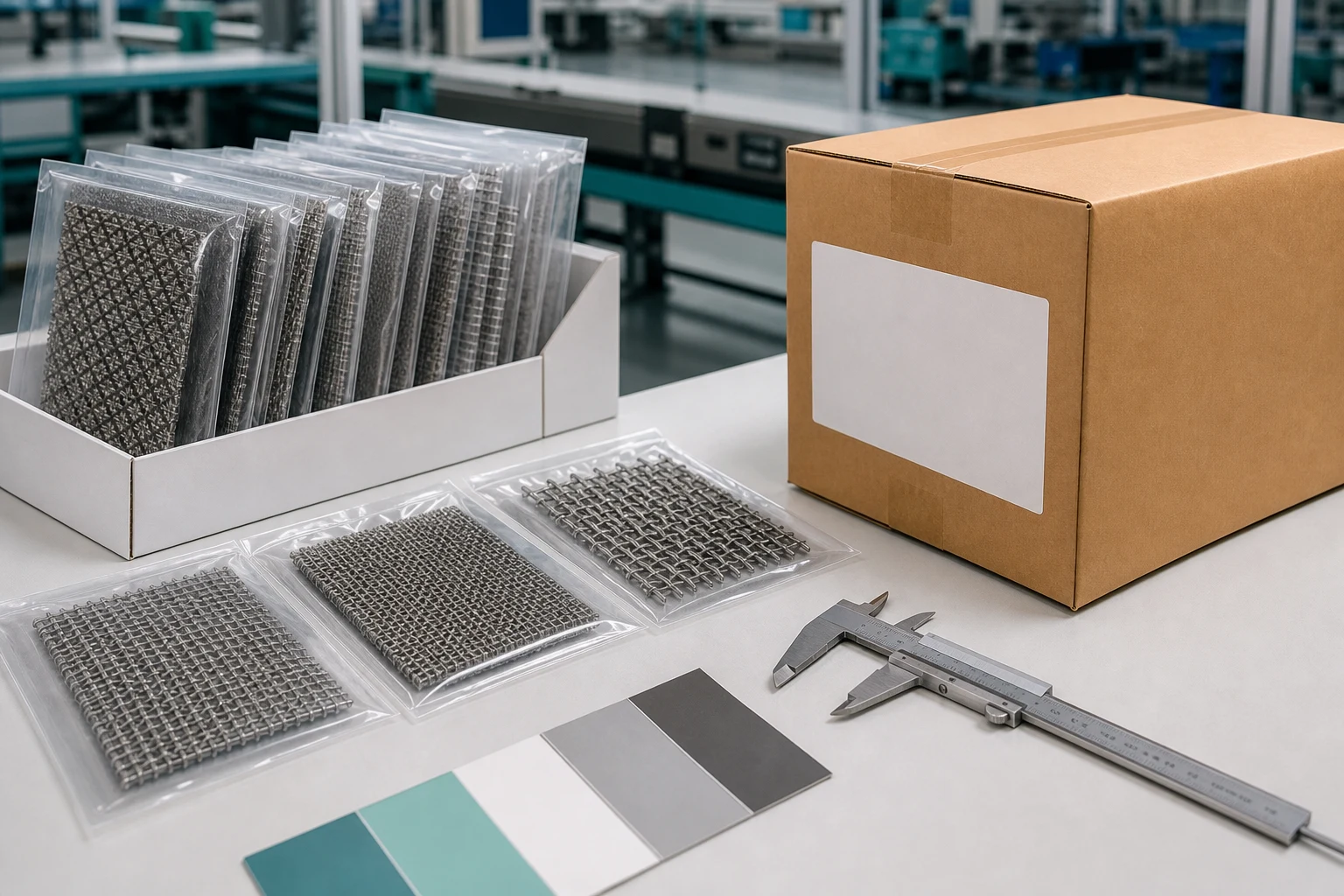
Packing deserves its own section. Ask for roll labels, lot or item separation, moisture protection, pallet or frame support, and a loading approach for mixed specifications. A good pack plan reduces crushed edges, coating abrasion, and receiving errors; it can also explain why two apparently similar offers have different freight or handling costs.
Keep the final RFQ short enough to use
The most effective RFQ is readable by purchasing, engineering, quality, and the supplier’s production team. Use a clear item table, attach the latest drawing or sample photographs, and list the few requirements that would make the product unacceptable. Leave a structured place for suppliers to declare assumptions and deviations instead of forcing them to hide those assumptions in an email note.
Before release, compare the RFQ against the application: would a receiving inspector know what to measure, and would a supplier know what must not change? If the answer is yes, the quotation process will produce more useful commercial data and fewer late-stage surprises.
Wire Mesh Guide covers practical sourcing and quality-control topics for buyers, engineers, and project teams. Read about our editorial approach or use the contact page to share a documented correction or a topic request.